Azawakh and the Terrible, Horrible, No Good, Rainy Day
November 30, 2008

Hello!

Stretch.

Good lord, it's raining.

High stepping.

Getting a move on.

Warming up.

Chase.

180.

Tag!

Wet, wet, wet.

What is this thing?
Pooped Pups
November 30, 2008
After several hours in the field chasing live critters and followed up with a day of chasing a plastic lure, these puppies are cooked. Plus the weather is vile today. Hovering around 40 degrees and raining. It’s a good day to snuggle on the couch and snooze.
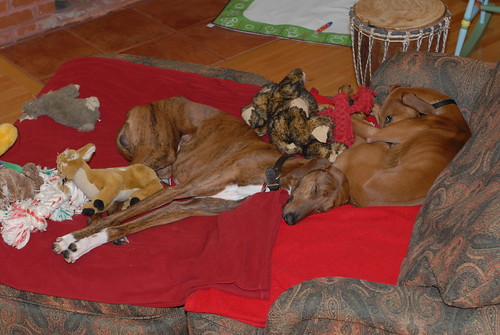
Azelouan and Tawzalt Snooze on the Couch
More Azawakh Color Genetics
November 26, 2008
Or Yet More Wrong Rules in the FCI Standard
Last time, I took a spin through coat color genetics in dogs and tool a look at some of the things in the Azawakh standard that don’t fit. I left out some finer points of discussion involving genes that convert black pigments to brown and/or blue.
Let’s start things off with some quotations from the FCI Azawakh standard and then we’ll take a look at whether they make any sense.
Nose: Nostrils are well opened. The nose is either black or brown.
Eyes: Almond shaped, quite large. Their color is dark or amber. Eyelids are pigmented.
Coat: … Black brindles are allowed.
Eliminating Faults: …
- Light eye: i.e., bird of prey eyes
Although these are color rules in the FCI Azawakh standard are outside of the discussion of the coat, the loci that control these traits also affects coat color.
The Liver Locus, B
- B – normal black
- b – black pigmentation converted to brown
The default color for noses in dogs is black. Brown noses are controlled by the the B or Liver locus. The recessive allele of this locus affects the production of eumalanin, converting all black in the coat to brown (aka liver). Saddles, shading, brindling and nose pigmentation are all converted from black to brown. Recessive B (bb) also causes amber eyes. When liver is expressed, anywhere there is black in the body of the dog it is converted to brown. It is impossible for a bb dog to have black anywhere in its coat.
Recall that brindle is controlled by the K or black locus. The dominant black K gene does not occur in Azawakh but the semi-dominant k(br) allele does occur as well as the k, non-black, allele. Any dog that has a k(br) gene will be black brindled, but if it also has recessive bb, then the bridling will be dark brown.
The amendment that added brindling contains a mistake. At the very least, it must be changed to allow black or brown brindling.
The Dilution Locus, D
ABIS has surveyed a few blue Azawakh in the Sahel and there have rarely been blue Azawakh born in the West. This can be expressed as either blue brindling or blue mask or both. Blue is controlled by the D locus.
- D – normal pigmentation
- d – dilute pigmentation
The recessive d allele primarily affects the production of eumalanin pigment, causing it to shift from black to blue. It also has a slight effect on red phaeomelanin pigment causing it to be less red.
The D locus can interact with the B locus. If a dog is both recessive liver (bb) and recessive blue (bb), then it will have Isablella black. Weimeraner’s are isabella colored.
Blue causes amber eyes.
Blue also affects nose pigmentation. In a blue dog, the nose cannot be black, it will be blue. In an Isabella dog, the nose is isabella which looks like brown with some blue tattooing.
Amber But Not Light Eyes?
I cannot understand what the difference is between amber and light eyes. Very light eyes occur in isabella dogs which must be both recessive for B and recessive for D, an excruciatingly rare combination in Azawakh. Most likely amber is caused by the expression of recessive B (liver). In a liver dog, there is no genetic difference between a dark amber and a lighter amber. These are just chance differences in development of pigment producing cells. Both are caused by the bb combination, which is allowed. Also, how light is light? When does amber become “bird of prey”? How many angels can dance on the head of a pin?
The light eye eliminating fault prohibition should be stricken.
A Re-Rewrite
Last time, I made a whack at rewriting the coat color rules. I mostly left out the discussion of dilution and brown loci. I need to update my rewrite to account for those loci.
…
Nose: Nostrils are well opened. The nose is black, brown, blue or isabella (blue + brown).
Eyes: Almond shaped, quite large. Eye color is any shade of brown or amber. Eyelids are pigmented.
…
Color: The base coat colors are forms of sable ranging from ivory to red and may be grizzled. Brindle markings may be present. Mask may be present. Mantle or saddle may be present. White on the extremities, with or without ticking, may be present including Irish marked and particolor patterns. Black markings may occur in the liver brown form, the dilute blue form or the combination blue + brown (isabella) form.
…
Eliminating Faults: …
- Light eye: i.e., bird of prey eyes
- Absence of any white marking at the extremity of one or more limbs.
Azawakh Coat Color Genetics
November 25, 2008
Or Why the Color Section of the FCI Standard is Indefensible
“Color: Fawn with flecking limited to the extremities. All shades are admitted from clear sand to dark red. The head may or may not have a black mask and the list is very inconsistent. The coat includes a white bib and a white brush at the tip of the tail. Each of the four limbs must have compulsorily a white ‘stocking’, at least in the shape of tracing on the foot. Black brindles are allowed.”
There are a number of known genetic loci (places) that control coat color in dogs. What we know about the genetics of coat coloration cannot be reconciled with the FCI color standard.
Sable Base Color
Azawakh have a base color of sable, also called red by many people. There are two main loci that control blackness or the lack thereof. The dominant black gene is at the K locus, which also controls brindling.
- K – dominant black
- k – recessive, allows the A locus to control base color
- k(br) – k(br) is the brindle gene. k(br) is recessive to K but dominant over k.
Black dogs are almost unknown in the Sahel. Selection works very well at removing dominant traits and we know there is a strong cultural bias against black animals because animist tradition teaches they are evil. Also the desert climate may exert strong selection pressure against K. The dominant black gene almost certainly does not exist in the Azawakh population.
Because K is not present, the base coat color of Azawakh is controlled by the Agouti locus. Agouti is largely about controlling the production and timing of black eumelanin pigment in the coat. When coat does not produce much eumalanin it allows us to see the inherent red, phaemlelanin, in the coat. There are five Agouti alleles.
- A(y) – sable red
- a(w) – agouti (grizzle)
- a(s) – black saddle or mantle
- a(t) – black with red extremities
- a – recessive black
In the Agouti series, the dominant allele is A(y) which is the basic red Azawakh. However, I believe that all 5 alleles exist in the general population. The a(t) and a alleles are rare because puppies that are black or mostly black would be culled, but because they are recessive it is difficult to remove them from the population entirely.
The “chinchilla” or C locus controls dilution of the red pigment, phaemlelanin. There are 4 alleles:
- C – dominant, normal red pigment
- c(ch) – chinchilla (yellow)
- c(e) – extreme chinchilla (lighter yellow)
- c(P) – Platinum (ivory)
The C locus is not very well understood. It is clear that the intensity of redness is controlled in recessive red dogs, like Azawakh, is controlled by the C locus. The C locus is thought to be a location of co-dominance, meaning that the recessive genes partially express when present. Different combinations of alleles from the C locus allow a range of redness from redk like an Irish Setter, to ivory, like a Samoyed. Clear sand is not specific, but it sounds like a very light yellow perhaps from a combination like c(e)c(P) or c(ch)c(P). If c(P) exists in order to create the “clear sand” color combination then c(P)c(P) is also possible, if rare. That dog would be pure white. How can one recessive combination of genes be allowed but another one is forbidden?
White Extremities
With the exception of whiteness due to red dilution at the C locus, white develops from the extremities. The locus that controls the “height” of whiteness is S, spotting. The dominant allele is S which is no white. Like the C locus, S is an example of incomplete or co-dominance.
- S – no white
- s(t) – Trim. Very small amounts of white on the tips of the toes and tail tip.
- s(i) – Irish pattern (like a border collie)
- s(p) – particolor pattern
- s(w) – extreme particolor (linked with deafness)
There is a huge problem with the standard in that it calls for an unstable color pattern. It requires either a heterozygous dog that carries one irish pattern gene or just random luck during development.
The most dominant allele is S, which is no white. However, dogs that are homozygous S (SS) can still often express a phenotype with a white bib and a trace of white on their toes and the tip of their tails. This white expression has no genetic basis! It is just a residual white pattern caused by pigment cells not spreading fully to the extremities during fetal development.
The classic white socks and bib pattern is probably requires heterozygosity in the form of s(t)s(i) or perhaps Ss(p) because if you have s(i)s(i) then you’ll have a classic Irish marked dog with a white collar which is now forbidden in France.
Think about this for a minute. Let’s say we have two dogs with just the right white socks and no collar marking. They are both Ss(i). First of all, it’s just luck that they don’t have a significant white spot on the neck but more importantly, their color pattern isn’t stable when crossed. 1/4 of the puppies will be s(i)s(i), one quarter will be SS and half will be Ss(i). Because of the residual white effect, some of the SS puppies may well be within the standard. Dogs that are s(i)s(i) may also fall within the norms and not have a white spot on the neck just by luck.
A standard that asks for white on the extremities but tries to avoid an Irish marked pattern is indefensible genetically. Also, eliminating the non-white SS dogs from the breeding population will tend to select for homozygous recessive Irish marked, s(i)s(i). That’s exactly the pattern we see playing out. The dogs in Europe are becoming more consistently Irish marked.
Ticking
The dominant ticking gene, T , is also clearly present.
- T – ticking
- t – no ticking.
The ticking gene is dominant over non-ticking. Ticking or roaning is small spots of the base color on white areas. Ticking usually expresses on legs, muzzle and chest. I have heard that in Europe some consider this “dirty markings” and select against it, but why? The oldest examples of Azawakh and many champion Azawakh had ticking in their white. Most Azawakh have small red “freckles” in their chests and socks.
Etc.
There are also dilution genes which can yield blue brindle and have some other effects, but since this is already too long I’ll save that for another post.
A Modest Rewrite
The color standard should be changed to match the reality of the genetics in the native population. I’d recommend something along these lines:
Color: The base coat colors are forms of sable ranging from ivory to red and may be grizzled. Brindle markings may be present. Mask may be present. Mantle or saddle may be present. White on the extremities, with or without ticking, may be present including Irish marked and particolor patterns. Black markings may occur in the dilute blue form.
Eliminating Faults: …
- Absence of any white marking at the extremity of one or more limbs.
Takuté Whelped 8 Puppies
November 24, 2008
Takuté Al-Ifriqiya (Kusaylah X Iman) has whelped 8 healthy puppies by Al Hara’s Vukuru. The litter contains 5 males and 3 females. Takuté is the full sister of Showq who was the grandam of my Tawzalt. Al Hara’s Vukuru is the full brother of Voodoo who sired the Kel Simoon M litter whelped by Borial this spring.
Takuté’s litter is mostly out of old European lines with the exception of the gransire which is Ajor Tin Akoff bred by Ayad ag Inachanan in Burkina Faso. Despite being from old lines, the breeding has a very low inbreeding coefficient.
If you are interested in puppies from this litter, contact Dr. Gabriele Meissan through her website, http://www.tombouktous-azawakhs.de. Gabi lives in Germany, but I believe she is willing to ship puppies just about anywhere in the world.
Azawakh are not Odorless
November 21, 2008
I’ve read in a number of places that Azawakh do not have a “doggy odor”. This strikes me as marketing hype. The implication is that the dogs are odor-free and that’s not true.
They have a smell but it is very different from the Labrador retriever dog smell that a lot of people are familiar with. The labrador smell is primarily caused by natural oxidation of the heavy oils in their coat. Basically, those dogs smell rancid.
Back to Azawakh.
Their basic smell is a kind of musk, somewhat horse-like. I find it a reasonably pleasant and earthy smell. My wife and daughters definitely do not always agree. If the dogs start to have a strong offensive odor it is invariably because of something they encountered outdoors and I’m sometimes obliged to give the dogs a bath.
Depending on the personality of dog, bathing ranges from easy to a battle royal. I don’t recommend bathing Azawakh any more often than you need to to have peace in your house. They have sensitive skin that isn’t very oily (hence the absence of the Labrador smell) and the shampoo will tend to dry them out and make their skin itchy and flaky.
I’ve had the best luck with detergent-free shampoos that also contain a source of fat, like Shea butter, lanolin and/or emu oil (from the flightless ostrich-like bird). These shampoos are obscenely expensive, which is another good disincentive for over-bathing.
Shea Pet shampoos contain fair trade Shea butter which is purchased from women’s cooperatives in Uganda. I got this stuff at a doggy day care around the corner from my house. Kenic (Glo-Marr) in Kentucky makes Kalaya Emu Oil Pet Shampoo. A friend recommended it to me and it works well, without unfortunate side-effects. The Kalaya stuff is less expensive than the Shea Pet stuff, but harder (for me) to find. I called around to all the local stores but finally bought a bottle on-line.
Mauritanian Bush Dog
October 27, 2008
Yesterday I ran into an interesting dog among a cluster of returned Peace Corps Volunteers (RPCVs) who served in Mauritania. The dog turned out to have been born along the coast of Mauratania near the capital of Naoukchott. Unlike the majority of Peace Corps Volunteers who either abandon thier dogs and cats at the end of their service or attempt to gift them to a new volunteer, this volunteer brought her dog home with her as we did.
I wish I had a picture, but the dog was a two-year old bitch. She was clear and with white paws and brush on her tail. Her hair was a bit coarse, but she had a very typical head except that her ears were erect. She looked like a small-ish Azawakh with erect ears. Her behavior was pure West Africa. She went through a pretty elaborate greeting with Tawzalt and Azelouan which started out with a suspicious posture and some teeth baring on both sides. The three of them quickly formed a small pack in order to course a slightly startled protugese water dog who eventually called a halt to by retreating to into a deep pool in the creek. I wish I had my camera with me, but alas.
The Mauratanian dog was of the type that some people call “senji” or basically dingo-like West African village dogs whose breeding is really not controlled by people. The senji dogs usually live among people who aren’t very dog-friendly and who consider them to be unclean. Azawakh, in my mind, represent an attenuated refinement of the basic senji type. The differences are superficial. This dog came from the coast, but the interesting thing to me was that the volunteers said that the dogs in the east of Mauritania looked more like Azelouan: taller, “often colored like that” (brindled) and more often havning dropped ears.

Known Azawakh range in grey; my expanded search area in green.
It shouldn’t be surprising. I would expect to find good specimens of Azawakh in the East of Mauritania. The Fulani are the primary ethnic group of black Africans in Mauritania. Historically, Mauritania was a part of the range of the Kel Tamasheq and in the 1990s many Tamansheq were forced to flee to refugee camps in Mauritania.
I realize this is controversial but as someone who has been around West Africa a bit I strongly suspect that good Azawakh specimens are to be found in a much larger area than ABIS has explored. I expect that we could find excellent specimens in Southern Algeria, Western Mali and also in Chad, northern Nigeria, Guinea and Benin, Central and Eastern Mauritania, Eastern Senegambia and maybe in the North of Cameroon, too. These lines on the map were drawn by colonial powers. I would expect to find the dogs wherever you find the Tamasheq and Fulani. These people are found throughout West Africa and as far east as the Sudan.
I doubt that ABIS could ever fund expeditions all over the Sahel to map the extent of the Azawakh range. I wonder if we could tap Peace Corps Volunteers for this research and, at the same time, encourage them to bring their dogs them when they return home to the States.
Myth: Azawakh will not Fetch
October 22, 2008
If you spend much time researching Azawakh temperament and behavior you are likely to read that they will not retrieve or “play fetch”. It’s not true. An Azawakh can learn to play the fetch game.
It is true that fetching is not an obsession with Azawakh like it is with many other “sporting” breeds. Azawakh have to learn that “fetch” is a fulfilling form of play and the dog has to be in the mood to play the game.
“Retrieve” is a natural behavior and a standard canid motor pattern. Wild canids “retrieve” game and bring it back to pups in the den, for example. Azawakh have this motor pattern, but it isn’t hypertrophied in the way that it is in modern gun dogs. The behavior is there but it is far from a compulsion. Azawakh can and will retrieve to hand. If the game is fun, the dog will play. It requires the right relationship between dog and handler.

Azawakh retrieving a tennis ball.
Run Puppy, Run
October 19, 2008

Bounce

Ricochet

Leap

Turn

Spring

Bound
Exciting Whelp at Idiiyat-es-Sahel
October 17, 2008
Tirout has whelped 5 pups at Idiyyat-es-Sahel. The puppies are sired by Tigidit Fasiqqi. I’m tremendously excited about this litter first because Tirout and Fasiqqi are great dogs to be around and beautiful, but also because they represent an injection of new blood from the Sahel that is essential for the survival of healthy Azawakh.
Tirout was imported from the Sahel by the Association Bukinabe Idi du Sahel (ABIS) 2007 expedition. Fasiqqi is the son of a dog collected in a previous expedition. They are also unusual in Western breeding because they carry recessive color combination genes which have been eliminated in the West by a combination of selective breeding and the random chance that the original foundation dogs were a particular color combination. While color is superficial, it is visually striking. Two of the puppies are particolored. They are mostly white.

Tirout's particolor puppies
In the 1980s and 1990s, the Azawakh gene pool in the West became increasingly restricted. In aggregate, the inbreeding coefficients were steadily increasing while the ancestral loss coefficients were declining. The inbreeding coefficient is a rough measure of the genetic sameness of a dogs ancestors. The ancestral loss coefficient is a measure of the number of distinct ancestors relative to the whole population. Rising inbreeding coefficient tends to indicate increasing sameness. Falling ancestral loss coefficient indicates that breeding lines are being eliminated from the gene pool.

Inbreeding coefficient (IK) vs. ancestral loss coefficient (AVK) in Azawakh bred in France.
This graph shows an alarming bottle-necking trend which can only end very badly for the dogs. Consider the Basenji, which is closely related to the Azawakh. Contemporary Western Basenji have a very high incidence of a number of serious genetic ailments including digestive disorders, hip displasia, progressive retinopathy (blindness) and Fanconi’s syndrome (kidney failure). They also no longer look very much like hounds in the Congo. Breeders must out-cross back to desert bred dogs or there is no doubt in my mind the Azawakh will suffer a similar fate.
These whelps are part of the key to maintaining Azawakh as a viable, healthy breed. I am very excited about these puppies.
Congratulations, Daoud.


 Aidi wan n'Eezel: the loyal azawakh