Coursing @ Hanover
December 2, 2008
While not really the same as chasing live critters, some Azawakh enjoy the lure coursing game.

Azelouan at the start line
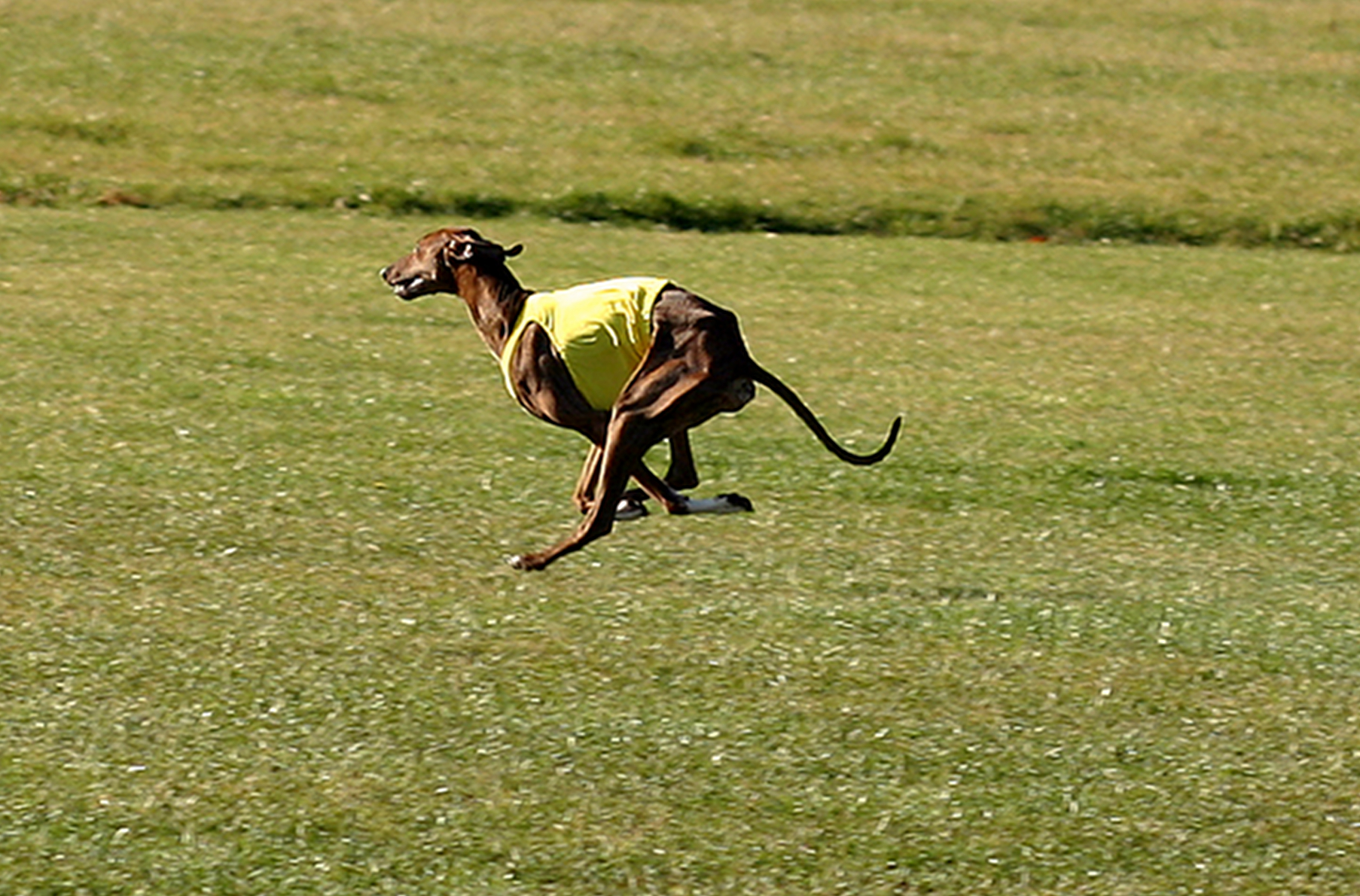
Azelouan coursing the lure
Images © 2008 Stir Greer.
Again With the Color Standards for Azawakh
December 1, 2008
Previously, I wrote about the color rules in the FCI standard for the Azawakh breed. The FCI or Fédération Cynologique Internationale is the governing body for purebred dog standards throughout Europe and most countries. At a high level, the way this works is the main body sets standards and policies in Belgium and then member kennel clubs in each country administer a registry. The big exception is the USA and England which have their own kennel clubs which set their own breed standards. I don’t know this definitively, but I’m guessing that since the Kennel Club (KC) and American Kennel Club (AKC) were founded in the 1890s by a number of uptight pretentious men they had very little interest in taking orders from a wholly separate set of uptight European pretentious men who only got around to organizing themselves in the 20th century.
The point I’m getting at here is that the AKC and KC can have totally different rules and standards for a breed than the FCI. In fact, they don’t even have to recognize the same breeds as the FCI.
Take Azawakh, for example.
The FCI recognizes Azawakh as an official breed with a rigid standard. The AKC recognizes Azawakh as a rare (foundation stock) breed which cannot even be shown in regular dog shows. The status as a foundation stock breed means that things like the registry and conformation standard for the Azawakh are in flux with the AKC and considered fungible. Some things have already been changed relative to the FCI standard: colors, for example.
The standard proposed by the American Azawakh Association for use by the AKC is the same as the FCI standard except where colors are concerned.
FCI Standard
Color: Fawn with flecking limited to the extremities. All shades are admitted from clear sand to dark red. The head may or may not have a black mask and the list is very inconsistent. The coat includes a white bib and a white brush at the tip of the tail. Each of the four limbs must have compulsorily a white “stocking”, at least in the shape of tracing on the foot. Black brindles are allowed.
Eliminating faults:
…
Absence of any white marking at the extremity of one or more limbs.
Light eyes; ie. bird of prey eyes.
Proposed AKC Standard
Color: Fawn, clear sand to dark fawn, brindle, white, black, grey, blue, grizzle, parti-color, and all shades of brown to include chocolate. The head may or may not have a black mask. There may be white markings on the legs, bib and at the tip of tail.
Eliminating faults:
…
Absence of any white marking at the extremity of one or more limbs.
Light eyes; ie. bird of prey eyes.
The standard proposed for the AKC is much better that the FCI one. Since it now includes everything but the kitchen sink, is it even meaningful or is it just a complicated tangle of words that nobody can possibly remember? Also, there are combinations of acceptable colors that would guarantee the eliminating fault of “light eyes”, such as homozygous blue dilution with homozygous liver (dd + bb). The light eye prohibition seems to be baseless.
Field studies conducted by ABIS have found that there Kel Tamasheq do not systematically select for particular colors. It seems to me that we should adopt the same lack of criteria. After all, the dogs are much more theirs than ours.
Color is a distraction that shouldn’t be driving the selection of Azawakh. I propose a straightforward and easy to remembe simplification that would make color a non-issue.
Straightforward Standard
Color: Any color combination is acceptable.
Eliminating faults:
…
Absence of any white marking at the extremity of one or more limbs.
Light eyes; ie. bird of prey eyes.
Azawakh and the Terrible, Horrible, No Good, Rainy Day
November 30, 2008

Hello!

Stretch.

Good lord, it's raining.

High stepping.

Getting a move on.

Warming up.

Chase.

180.

Tag!

Wet, wet, wet.

What is this thing?
Pooped Pups
November 30, 2008
After several hours in the field chasing live critters and followed up with a day of chasing a plastic lure, these puppies are cooked. Plus the weather is vile today. Hovering around 40 degrees and raining. It’s a good day to snuggle on the couch and snooze.
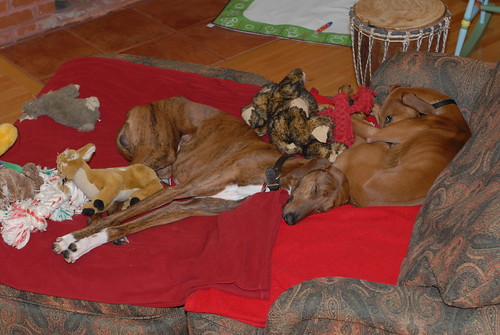
Azelouan and Tawzalt Snooze on the Couch
“Buy One Get One Killed”
November 26, 2008
PETA ran an appalling ad campaign Dog Fancy magazine. They put an ad offering a free gift bag to purchasers of purebred puppies. When you call the 1-800 number you discover it is actually a body bag for the “dog you killed” by purchasing a purebred puppy instead of a shelter dog. They have also produced companion videos.
This is the most unethical and mean-spirited propaganda campaign I have ever heard of outside of a George Orwell novel.

Click to Watch Video
Well.
Perhaps the best place to start is the hypocrisy. According to their own records PETA kills over 90% of the animals placed in their care, close to 20,000 dogs in a 10-year period.
Where’s the moral equivalence? I’m not responsible for the action of others.
A dog which has been abandoned to a shelter for some reason (perhaps there is something wrong with it?) is not equivalent to a puppy hand-raised by a knowledgeable and dedicated breeder.
The Big Lie
PETA and HSUS have huge budgets in the hundreds of millions of dollars that they receive in donations from animal lovers. Rather than use that money to attempt to reform shelters, they go on killing dogs and cats. Then they produce propaganda campaigns blaming the killing that they themselves endorse and participate in on purebred dog/cat owners and breeders. What they really want to do is just eliminate all of the dogs and cats by eliminating the breeders. That’s the big lie.
Wayne Pacelle of HSUS on DC Radio Show
November 26, 2008
Wayne Pacelle was on the Kojo Nambe show, a local DC politics radio show on WAMU, our local public radio station. Mr. Pucelle is extremely careful to try to sound reasonable. He’s trying to back away from the label of “animal rights” in favor of “animal protection” or “animal welfare” because he claims to not believein natural rights at all. He says his goal is to build the HSUS to be a “formidable political player” along the model of the NRA. He talks about puppy mills and defines them to contain thousands of animals, but I know the reality is that the HSUS is promoting onerous rules to discourage breeding dogs in homes.
Pucelle claims that a shelter is the best place to procure a dog. The best place to procure a dog is not at a shelter. The best place is from a caring breeder.
One thing Pucelle said was correct: “A lot of people view animals as property. They haven’t kind of crossed the threshold of recognizing them as living, breathing, fealing creatures.”
That’s right. Domestic animals are property and the right to own property is protected by the US Constitution. My dogs are living breathing creatures that belong to me. I don’t want that to change to animals being wards of the State or the HSUS.
He talks about fringe activites as rationales for stripping the rights from eveyone else. One of the callers accused him of dissembling in order to get the camel’s nose under the tent and he evaded the question. I found the interview chilling.
I’m dissapointed in Kojo for hosting this softball interview which amounted to a fundraiser for the HSUS.
More Azawakh Color Genetics
November 26, 2008
Or Yet More Wrong Rules in the FCI Standard
Last time, I took a spin through coat color genetics in dogs and tool a look at some of the things in the Azawakh standard that don’t fit. I left out some finer points of discussion involving genes that convert black pigments to brown and/or blue.
Let’s start things off with some quotations from the FCI Azawakh standard and then we’ll take a look at whether they make any sense.
Nose: Nostrils are well opened. The nose is either black or brown.
Eyes: Almond shaped, quite large. Their color is dark or amber. Eyelids are pigmented.
Coat: … Black brindles are allowed.
Eliminating Faults: …
- Light eye: i.e., bird of prey eyes
Although these are color rules in the FCI Azawakh standard are outside of the discussion of the coat, the loci that control these traits also affects coat color.
The Liver Locus, B
- B – normal black
- b – black pigmentation converted to brown
The default color for noses in dogs is black. Brown noses are controlled by the the B or Liver locus. The recessive allele of this locus affects the production of eumalanin, converting all black in the coat to brown (aka liver). Saddles, shading, brindling and nose pigmentation are all converted from black to brown. Recessive B (bb) also causes amber eyes. When liver is expressed, anywhere there is black in the body of the dog it is converted to brown. It is impossible for a bb dog to have black anywhere in its coat.
Recall that brindle is controlled by the K or black locus. The dominant black K gene does not occur in Azawakh but the semi-dominant k(br) allele does occur as well as the k, non-black, allele. Any dog that has a k(br) gene will be black brindled, but if it also has recessive bb, then the bridling will be dark brown.
The amendment that added brindling contains a mistake. At the very least, it must be changed to allow black or brown brindling.
The Dilution Locus, D
ABIS has surveyed a few blue Azawakh in the Sahel and there have rarely been blue Azawakh born in the West. This can be expressed as either blue brindling or blue mask or both. Blue is controlled by the D locus.
- D – normal pigmentation
- d – dilute pigmentation
The recessive d allele primarily affects the production of eumalanin pigment, causing it to shift from black to blue. It also has a slight effect on red phaeomelanin pigment causing it to be less red.
The D locus can interact with the B locus. If a dog is both recessive liver (bb) and recessive blue (bb), then it will have Isablella black. Weimeraner’s are isabella colored.
Blue causes amber eyes.
Blue also affects nose pigmentation. In a blue dog, the nose cannot be black, it will be blue. In an Isabella dog, the nose is isabella which looks like brown with some blue tattooing.
Amber But Not Light Eyes?
I cannot understand what the difference is between amber and light eyes. Very light eyes occur in isabella dogs which must be both recessive for B and recessive for D, an excruciatingly rare combination in Azawakh. Most likely amber is caused by the expression of recessive B (liver). In a liver dog, there is no genetic difference between a dark amber and a lighter amber. These are just chance differences in development of pigment producing cells. Both are caused by the bb combination, which is allowed. Also, how light is light? When does amber become “bird of prey”? How many angels can dance on the head of a pin?
The light eye eliminating fault prohibition should be stricken.
A Re-Rewrite
Last time, I made a whack at rewriting the coat color rules. I mostly left out the discussion of dilution and brown loci. I need to update my rewrite to account for those loci.
…
Nose: Nostrils are well opened. The nose is black, brown, blue or isabella (blue + brown).
Eyes: Almond shaped, quite large. Eye color is any shade of brown or amber. Eyelids are pigmented.
…
Color: The base coat colors are forms of sable ranging from ivory to red and may be grizzled. Brindle markings may be present. Mask may be present. Mantle or saddle may be present. White on the extremities, with or without ticking, may be present including Irish marked and particolor patterns. Black markings may occur in the liver brown form, the dilute blue form or the combination blue + brown (isabella) form.
…
Eliminating Faults: …
- Light eye: i.e., bird of prey eyes
- Absence of any white marking at the extremity of one or more limbs.
Azawakh Coat Color Genetics
November 25, 2008
Or Why the Color Section of the FCI Standard is Indefensible
“Color: Fawn with flecking limited to the extremities. All shades are admitted from clear sand to dark red. The head may or may not have a black mask and the list is very inconsistent. The coat includes a white bib and a white brush at the tip of the tail. Each of the four limbs must have compulsorily a white ‘stocking’, at least in the shape of tracing on the foot. Black brindles are allowed.”
There are a number of known genetic loci (places) that control coat color in dogs. What we know about the genetics of coat coloration cannot be reconciled with the FCI color standard.
Sable Base Color
Azawakh have a base color of sable, also called red by many people. There are two main loci that control blackness or the lack thereof. The dominant black gene is at the K locus, which also controls brindling.
- K – dominant black
- k – recessive, allows the A locus to control base color
- k(br) – k(br) is the brindle gene. k(br) is recessive to K but dominant over k.
Black dogs are almost unknown in the Sahel. Selection works very well at removing dominant traits and we know there is a strong cultural bias against black animals because animist tradition teaches they are evil. Also the desert climate may exert strong selection pressure against K. The dominant black gene almost certainly does not exist in the Azawakh population.
Because K is not present, the base coat color of Azawakh is controlled by the Agouti locus. Agouti is largely about controlling the production and timing of black eumelanin pigment in the coat. When coat does not produce much eumalanin it allows us to see the inherent red, phaemlelanin, in the coat. There are five Agouti alleles.
- A(y) – sable red
- a(w) – agouti (grizzle)
- a(s) – black saddle or mantle
- a(t) – black with red extremities
- a – recessive black
In the Agouti series, the dominant allele is A(y) which is the basic red Azawakh. However, I believe that all 5 alleles exist in the general population. The a(t) and a alleles are rare because puppies that are black or mostly black would be culled, but because they are recessive it is difficult to remove them from the population entirely.
The “chinchilla” or C locus controls dilution of the red pigment, phaemlelanin. There are 4 alleles:
- C – dominant, normal red pigment
- c(ch) – chinchilla (yellow)
- c(e) – extreme chinchilla (lighter yellow)
- c(P) – Platinum (ivory)
The C locus is not very well understood. It is clear that the intensity of redness is controlled in recessive red dogs, like Azawakh, is controlled by the C locus. The C locus is thought to be a location of co-dominance, meaning that the recessive genes partially express when present. Different combinations of alleles from the C locus allow a range of redness from redk like an Irish Setter, to ivory, like a Samoyed. Clear sand is not specific, but it sounds like a very light yellow perhaps from a combination like c(e)c(P) or c(ch)c(P). If c(P) exists in order to create the “clear sand” color combination then c(P)c(P) is also possible, if rare. That dog would be pure white. How can one recessive combination of genes be allowed but another one is forbidden?
White Extremities
With the exception of whiteness due to red dilution at the C locus, white develops from the extremities. The locus that controls the “height” of whiteness is S, spotting. The dominant allele is S which is no white. Like the C locus, S is an example of incomplete or co-dominance.
- S – no white
- s(t) – Trim. Very small amounts of white on the tips of the toes and tail tip.
- s(i) – Irish pattern (like a border collie)
- s(p) – particolor pattern
- s(w) – extreme particolor (linked with deafness)
There is a huge problem with the standard in that it calls for an unstable color pattern. It requires either a heterozygous dog that carries one irish pattern gene or just random luck during development.
The most dominant allele is S, which is no white. However, dogs that are homozygous S (SS) can still often express a phenotype with a white bib and a trace of white on their toes and the tip of their tails. This white expression has no genetic basis! It is just a residual white pattern caused by pigment cells not spreading fully to the extremities during fetal development.
The classic white socks and bib pattern is probably requires heterozygosity in the form of s(t)s(i) or perhaps Ss(p) because if you have s(i)s(i) then you’ll have a classic Irish marked dog with a white collar which is now forbidden in France.
Think about this for a minute. Let’s say we have two dogs with just the right white socks and no collar marking. They are both Ss(i). First of all, it’s just luck that they don’t have a significant white spot on the neck but more importantly, their color pattern isn’t stable when crossed. 1/4 of the puppies will be s(i)s(i), one quarter will be SS and half will be Ss(i). Because of the residual white effect, some of the SS puppies may well be within the standard. Dogs that are s(i)s(i) may also fall within the norms and not have a white spot on the neck just by luck.
A standard that asks for white on the extremities but tries to avoid an Irish marked pattern is indefensible genetically. Also, eliminating the non-white SS dogs from the breeding population will tend to select for homozygous recessive Irish marked, s(i)s(i). That’s exactly the pattern we see playing out. The dogs in Europe are becoming more consistently Irish marked.
Ticking
The dominant ticking gene, T , is also clearly present.
- T – ticking
- t – no ticking.
The ticking gene is dominant over non-ticking. Ticking or roaning is small spots of the base color on white areas. Ticking usually expresses on legs, muzzle and chest. I have heard that in Europe some consider this “dirty markings” and select against it, but why? The oldest examples of Azawakh and many champion Azawakh had ticking in their white. Most Azawakh have small red “freckles” in their chests and socks.
Etc.
There are also dilution genes which can yield blue brindle and have some other effects, but since this is already too long I’ll save that for another post.
A Modest Rewrite
The color standard should be changed to match the reality of the genetics in the native population. I’d recommend something along these lines:
Color: The base coat colors are forms of sable ranging from ivory to red and may be grizzled. Brindle markings may be present. Mask may be present. Mantle or saddle may be present. White on the extremities, with or without ticking, may be present including Irish marked and particolor patterns. Black markings may occur in the dilute blue form.
Eliminating Faults: …
- Absence of any white marking at the extremity of one or more limbs.
Takuté Whelped 8 Puppies
November 24, 2008
Takuté Al-Ifriqiya (Kusaylah X Iman) has whelped 8 healthy puppies by Al Hara’s Vukuru. The litter contains 5 males and 3 females. Takuté is the full sister of Showq who was the grandam of my Tawzalt. Al Hara’s Vukuru is the full brother of Voodoo who sired the Kel Simoon M litter whelped by Borial this spring.
Takuté’s litter is mostly out of old European lines with the exception of the gransire which is Ajor Tin Akoff bred by Ayad ag Inachanan in Burkina Faso. Despite being from old lines, the breeding has a very low inbreeding coefficient.
If you are interested in puppies from this litter, contact Dr. Gabriele Meissan through her website, http://www.tombouktous-azawakhs.de. Gabi lives in Germany, but I believe she is willing to ship puppies just about anywhere in the world.
Obamas Choose Sidwell Friends School
November 22, 2008
The Obama’s have chosen to send their two daughters to Sidwell Friends School, which is a great school and the same one that Chelsea Clinton attended. Sidwell has a lower and upper school campuses they offer Quaker education from K through High School. The other Quaker school in town is the School for Friends preschool which offers early childhood education through pre-K, also.
Our children attend/attended School for Friends and I can’t say enough good things about School for Friends and its director Jim Clay. It is a wonderful place where children blossom. I’m told that Sidwell is also a great school. There’s just one major difference. Sidwell is an “elite” school and the tuition is eye-popping.
Last year we were looking at kindergartens for our older daughter. Our local in-district public school is deplorable on every level. We looked at private school programs and were shocked at the expense. Sidwell topped the list at roughly $26,000/yr plus the expectation of donations. Sidwell is setting the trend. Other schools have tuition within 10% of the ceiling set by Sidwell. The really frightening thing is that tuition prices are rising at about 10% a year, well above the rate of inflation and certainly faster than our salaries could possibly increase. This year the tuition to the lower school is $28,500 and for the upper school it is $29,500. “Aftercare” programs are additional. If you and your spouse/partner have jobs that will not allow you to pick up your children at 3pm then factor in another $10,000 – $15,000.
In DC, the real estate prices are so high that a small three bedroom 16,000 square foot town house is a minimum of $450,000 in a bad neighborhood and more likely $600,000 to $800,000. That translates into mortgage payments of $3,000 to $5,000 per month. Sending one child to a private school like Sidwell amounts to payments of about $3,000 per month. Two children, is $6,000. For a family with two children, that’s about $10,000 per month just for housing and school. That’s $120,000 after taxes which requires a combined pre-tax salary of $160,000 just to pay for school and housing. We haven’t taken into account health/life insurance, car payments, fuel, utilities, food, clothing or entertainment. Let’s peg those items at a minimum of $3000 per month at DC prices or $36,000 per year.
Basically in order to send two kids to private school while living in DC, you have a household income of over $200,000 per year. Even that number is optimistic because it means that you have zero savings for anything, including retirement. If, like the vast majority of DC residents, you make less than $200,000 and you cannot get your children into one of the good public schools, then you have no choice but to leave the city. The deplorable state of DC public schools and the impressive expense of private schools are forcing a steady exodus of young and talented families from the city out to Northern Virginia and Montgomery County, MD.
I had a small hope that if the Obamas put their children into a public school, then it would have put wind into the sails of public school reform, but that clearly isn’t going to happen.


 Aidi wan n'Eezel: the loyal azawakh