Escape Artist
November 22, 2008
You just have to root for this little guy. He’s smart and determined to be free.
Azawakh are not Odorless
November 21, 2008
I’ve read in a number of places that Azawakh do not have a “doggy odor”. This strikes me as marketing hype. The implication is that the dogs are odor-free and that’s not true.
They have a smell but it is very different from the Labrador retriever dog smell that a lot of people are familiar with. The labrador smell is primarily caused by natural oxidation of the heavy oils in their coat. Basically, those dogs smell rancid.
Back to Azawakh.
Their basic smell is a kind of musk, somewhat horse-like. I find it a reasonably pleasant and earthy smell. My wife and daughters definitely do not always agree. If the dogs start to have a strong offensive odor it is invariably because of something they encountered outdoors and I’m sometimes obliged to give the dogs a bath.
Depending on the personality of dog, bathing ranges from easy to a battle royal. I don’t recommend bathing Azawakh any more often than you need to to have peace in your house. They have sensitive skin that isn’t very oily (hence the absence of the Labrador smell) and the shampoo will tend to dry them out and make their skin itchy and flaky.
I’ve had the best luck with detergent-free shampoos that also contain a source of fat, like Shea butter, lanolin and/or emu oil (from the flightless ostrich-like bird). These shampoos are obscenely expensive, which is another good disincentive for over-bathing.
Shea Pet shampoos contain fair trade Shea butter which is purchased from women’s cooperatives in Uganda. I got this stuff at a doggy day care around the corner from my house. Kenic (Glo-Marr) in Kentucky makes Kalaya Emu Oil Pet Shampoo. A friend recommended it to me and it works well, without unfortunate side-effects. The Kalaya stuff is less expensive than the Shea Pet stuff, but harder (for me) to find. I called around to all the local stores but finally bought a bottle on-line.
Ted Stevens is Gone
November 20, 2008
Ted Stevens will not be returning to Washington. It’s the end of an era and I am not nostalgic.
After more than two weeks of ballot counting, it’s now clear that senator Ted Stevens will not be returning to Washington. That lets the Republican senate caucus off the hook a bit. It was looking like they might have to decide whether to kick the guy out or filibuster to keep a convicted felon in his seat.
I guess I’m happy at this little piece of sanity. It means that even in Alasksa a majority of people don’t want a felon to represent them. By his own description Stevens has always been a “mean, miserable SOB”. I’m not sorry to see him go.
Off-topic a bit. Wouldn’t it be nice if the government paid you a check every year instead of you paying to fund government services? It might skew your perspective on your government leaders a bit. I can imagine thinking this guy is creepy but everyone is getting a check for $1654. Good job!
The state of Alaska writes oil dividend checks to its citizens. Also it is the happy recipient of millions of dollars from “rich uncle Ted” in the Senate. Remember that bridge to nowhere that Sara Palin claimed to have said “thanks, but no thanks” to? That’s not exactly what happened. Alaska took the money (“thanks”) but didn’t build the bridge (“but no thanks”).
Don’t Get a Politically Correct Dog, Mr. Obama
November 17, 2008
Get your girls the puppy they deserve and that you promised them.
A friend commented today that Mr. Obama should not feel compelled to get a shelter dog. I couldn’t agree more. Mr. Obama should not feel compelled to get a dog from a shelter. He should get the dog that is right for his family.
The primary criterion for the Obama household is that the Malia Obama is allergic to dog dander. They need a hypoallergenic dog. That list is fairly rarified1:
- Poodle
- Wheaton Terrier
- Schnauzer
- Portugese Water Dog
- Bichon Frise
- Mexican Hairless (Xoloitzcuintli)
- A few miniature breeds
The thing is that all of these are purebred. Why isn’t that OK? Mr. Obama noted that most shelter dogs “tend to be muts. Like me.” The problem is that it is harder to be sure that the dog will be hypoallergenic.
The AKC ran a poll this summer which concluded that the Obama’s should get a poodle. A standard poodle is a great dog. If that is too French or something, then I suggest a Portuguese Water Dog. I generally think a medium to large dog is best with kids because they are both energetic and durable enough to be a lot of fun and a great companion.
While it is is possible to get a great dog from a shelter it is more likely to get a dog that has some emotional and/or health problems. Is that the best thing for children to experience as their first dog?
Futhermore, I watched Mr. Obama give a very moving victory speech November 4th. He promised those kids a puppy. A puppy is not the same as an adult shelter dog. There is a special magic to raising a puppy. The Obama girls are in for a whirlwind of craziness. They deserve to have the special joy of raising a puppy as a part of their childhood.
Mr. Obama, don’t let the Animal Rights lobby take that away from your girls. Give them the puppy you promised.
1This list is not comprehensive.
Cool Video of Hunting Saluki
November 8, 2008
This video is from the PBS series, Nature. The clip is from part II of the two-part episode, “Dogs that Changed the World”. It shows desert bred saluki being coursed by Bedou in Jordan. There’s also a cool computer-generated sequence of the dog running with it’s skin off so it is a running skeleton.

Click to watch video
Proposition 2 Passed
November 7, 2008
California voters passed Proposition 2 to enshrine the right for chickens to have larger cages and also Proposition 8 to take away marriage rights for same-sex couples.
I leave it to Tom Toles to say it with a cartoon.
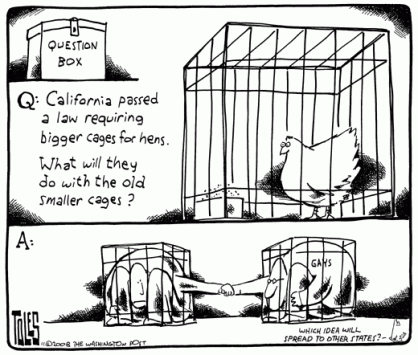
(c) Tom Toles, washingtonpost.com
Belated Halloween
November 7, 2008


Freaky Tropical Parisites
November 6, 2008
The Sahel can be a very harsh place for animals. Living there, I came to really appreciate the power of a little hard frost from time-to-time. In addition to familiar parasites like roundworms, tapeworms and heartworms there are other-worldly parasites that can give you nightmares.
In particular, I’m thinking of “tumbu” worm. This thing is actually not a worm at all but rather a general term for bot fly. These flies lay their eggs on an animal (or clothes) and the maggot burrows into the skin where it takes up residence until it matures into an adult fly which crawls out of the skin. Ugh.
Botfly are common all along the Niger, Gambia and Senegal river basins, particularly after the rains come. Most sheep, goats, cattle, dogs and even people have these maggots crawling in their skins.
It turns out that Ivermectin, which is marketed as Heartguard, is totally effective against botfly. If you are living in an area where botfly is endemic, regular doses of Ivermectin will prevent your dog from being infected. In part because we were careful where we hung our laundry and also because we gave our dog Ivermectin (labelled for cattle), I never had to extract any maggots from anyone in my household.
I have extracted the damn things from dogs and people, though. It’s enough to give you nightmares.
Think Aliens.
The video below was shot in Costa Rica, but the horror is the same.
Be Skeptical of Proposition 2
October 27, 2008
Over the weekend, I read an article on the Humane Society of the United States (HSUS) and California’s Proposition 2 november ballot initiative in the NY Times Magazine. The gist is that duing the November 4 presidential elections in California people will be voting on whether to limit the confinement of farm animals.
The official summary of the law is this:
- Requires that calves raised for veal, egg-laying hens and pregnant pigs be confined only in ways that allow these animals to lie down, stand up, fully extend their limbs and turn around freely.
- Exceptions made for transportation, rodeos, fairs, 4-H programs, lawful slaughter, research and veterinary purposes.
- Provides misdemeanor penalties, including a fine not to exceed $1,000 and/or imprisonment in jail for up to 180 days.
It sounds reasonable, right? Everyone can agree that animals should not be treated cruelly, but let’s remember that it is already illegal to keep animals in a cruel manner. The law is redundant and it is also potentially dangerous. It is no accident that they are targeting California rather than Iowa with this measure. Iowans would be more likely to realize that the purpose of farrowing pens is to protect piglets from being crushed under the sow, for example.
The real purpose of this law – which was drafted by the HSUS and the Farm Sanctuary and is endorsed by PETA among other Animal Rights groups – is to to take a step toward changing the legal status of animals from property to sentient entities embued with natural rights and from there to equate animal husbandry with slavery and eliminate domestic animals. Does that sound paranoid?
Here are some eye opening quotes.
“We have no ethical obligation to preserve the different breeds of livestock produced through selective breeding …One generation and out. We have no problems with the extinction of domestic animals. They are creations of human selective breeding.”
Wayne Pacelle, President of the HSUS
The HSUS president wants to give domesticated animals so many rights that it is impossible to keep them. Free to be extinct. Others Animal Rights leaders are apparently self-loathing and would just as soon see humans extinct for the good of the animals.
“The life of an ant and the life of my child should be accorded equal respect.”
Michael W. Fox, Sr. Scholar at HSUS
“I am not a morose person, but I would rather not be here. I don’t have any reverence for life, only for the entities themselves. I would rather see a blank space where I am. This will sound like fruitcake stuff again but at least I wouldn’t be harming anything.”
Ingrid Newkirk, PETA
A little know provision of this law is that it grants vigilante authority to any group of greater than 20 citizens that form a non-profit anti-cruelty corporation.
Under California Corporations Code Sections 10400 – 10406: “Corporations for the prevention of cruelty to… animals… may be formed under the Nonprofit Public Benefit Corporation Law… by 20 or more persons, who shall be citizens and residents of this state.”
Be very skeptical of Proposition 2.
Rather than enacting punitive new laws that create a vigilante poultry police, we should be looking at the insanity of our Farm Bill which has destroyed the family farmer in favor of a corporate-owned mass production system that basically converts petroleum into food. It is because of our bizarre farm subsidies that we live in an insane world where a Big Mac with fries and a Coke costs less than a head of broccoli.
Mauritanian Bush Dog
October 27, 2008
Yesterday I ran into an interesting dog among a cluster of returned Peace Corps Volunteers (RPCVs) who served in Mauritania. The dog turned out to have been born along the coast of Mauratania near the capital of Naoukchott. Unlike the majority of Peace Corps Volunteers who either abandon thier dogs and cats at the end of their service or attempt to gift them to a new volunteer, this volunteer brought her dog home with her as we did.
I wish I had a picture, but the dog was a two-year old bitch. She was clear and with white paws and brush on her tail. Her hair was a bit coarse, but she had a very typical head except that her ears were erect. She looked like a small-ish Azawakh with erect ears. Her behavior was pure West Africa. She went through a pretty elaborate greeting with Tawzalt and Azelouan which started out with a suspicious posture and some teeth baring on both sides. The three of them quickly formed a small pack in order to course a slightly startled protugese water dog who eventually called a halt to by retreating to into a deep pool in the creek. I wish I had my camera with me, but alas.
The Mauratanian dog was of the type that some people call “senji” or basically dingo-like West African village dogs whose breeding is really not controlled by people. The senji dogs usually live among people who aren’t very dog-friendly and who consider them to be unclean. Azawakh, in my mind, represent an attenuated refinement of the basic senji type. The differences are superficial. This dog came from the coast, but the interesting thing to me was that the volunteers said that the dogs in the east of Mauritania looked more like Azelouan: taller, “often colored like that” (brindled) and more often havning dropped ears.

Known Azawakh range in grey; my expanded search area in green.
It shouldn’t be surprising. I would expect to find good specimens of Azawakh in the East of Mauritania. The Fulani are the primary ethnic group of black Africans in Mauritania. Historically, Mauritania was a part of the range of the Kel Tamasheq and in the 1990s many Tamansheq were forced to flee to refugee camps in Mauritania.
I realize this is controversial but as someone who has been around West Africa a bit I strongly suspect that good Azawakh specimens are to be found in a much larger area than ABIS has explored. I expect that we could find excellent specimens in Southern Algeria, Western Mali and also in Chad, northern Nigeria, Guinea and Benin, Central and Eastern Mauritania, Eastern Senegambia and maybe in the North of Cameroon, too. These lines on the map were drawn by colonial powers. I would expect to find the dogs wherever you find the Tamasheq and Fulani. These people are found throughout West Africa and as far east as the Sudan.
I doubt that ABIS could ever fund expeditions all over the Sahel to map the extent of the Azawakh range. I wonder if we could tap Peace Corps Volunteers for this research and, at the same time, encourage them to bring their dogs them when they return home to the States.


 Aidi wan n'Eezel: the loyal azawakh